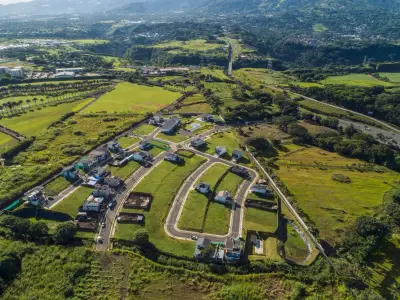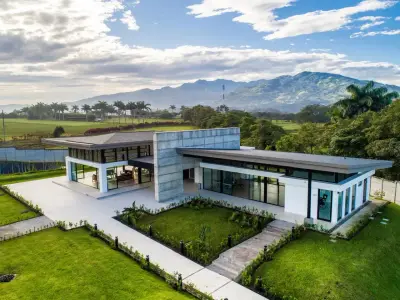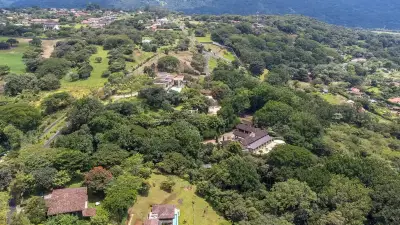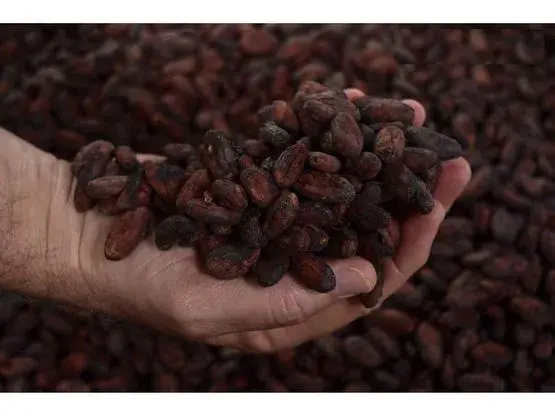
BETANIA cacao farm in San Carlos, Costa Rica. 132 ha total area, divided into 3 main sectors: 34 ha of planted cacao plants, 52 ha ready for planting, and 46 ha of protected forest for the farm's water supply. 3 streams cross the farm, and the San Carlos River forms one of its boundaries. The farm has a nursery for 10,000 plants. Finished product packaging building with all equipment operational, warehouses, dining area, and employee restrooms. Cacao internationally awarded at the Paris Chocolate Festival in 2013. 17 high-production clones.
Summary of both farms:
The number of cacao trees planted to date is approximately 100,000 units (for nearly 100 planted hectares, making it the largest cacao farm in Costa Rica).
Each farm has been strategically planted in each of its lots, according to production needs, soil analysis, and the best applicable clone varieties in each zone. Hence the diversity, with some lots planted 11 years ago and others only 1 year old. Approximately 25 hectares remain to be planted.
It is important to highlight that the Cadmium level is less than 0.20 mg/kg in all lots of both farms, which gives great prestige to the cacao, not only for its quality but because this level of heavy metals is extremely low and approved by the European Union.
The clones planted on the farms are of high quality in their flavors (demonstrated in various international competitions with different awards), with very high production levels, and with protection against diseases such as monilia, among others.
Each lot has traceability of which clones have been planted, the quantities, and the respective planting dates, being the only farm in the country with this traceability system. Similarly, some lots have fertigation if necessary, an exclusive irrigation system not used on other farms in the country.
Each farm has a wood-fired cacao bean dryer, which is used in case of low sun levels for drying the cacao beans.
The estimated dry cacao production level for this year is around 40 MT, and 55 MT for 2022, consequently, according to the aging of the trees, it will reach 200 MT by 2030.
Estimated income, between cacao and other by-products (such as twigs, pods, and others), in 2021 will be around USD $350,000, reaching USD $765,000 annually by 2030, keeping production costs around USD $245,000. Depending on plantation management, regarding pruning and more intensive fertilization, production levels could increase, but that will depend on cash flow. The cost level would remain stable even with higher production volume.